Seed offers a cost advantage
One of the main advantages of growing Dahlias from seed is cost. In general, seed is more economical than both cuttings and tubers. Especially when working with larger quantities, this can make seed an attractive starting material.
But the advantages go beyond the initial price. Seed is compact, easy to store and simple to transport. Compared with cuttings and particularly tubers, much larger quantities can be stored and shipped in a relatively small space. This can make handling, storage and logistics considerably easier.
A clean start
Seed also offers an advantage when it comes to plant health. Vegetatively propagated material, such as cuttings and tubers, can carry diseases or viruses from one generation of plants to the next. Starting from seed can reduce this risk and provides growers with a clean starting point.
This doesn't mean that seed-grown Dahlias cannot encounter diseases during cultivation, but the propagation method can help reduce the risk of carrying certain problems over from the mother plant or previous crop.
More flexibility – and more surprises
Seed production also offers flexibility. Seed can be stored relatively easily and is available as a compact starting material whenever production is needed. This can make it easier to respond to changing demand and production requirements.
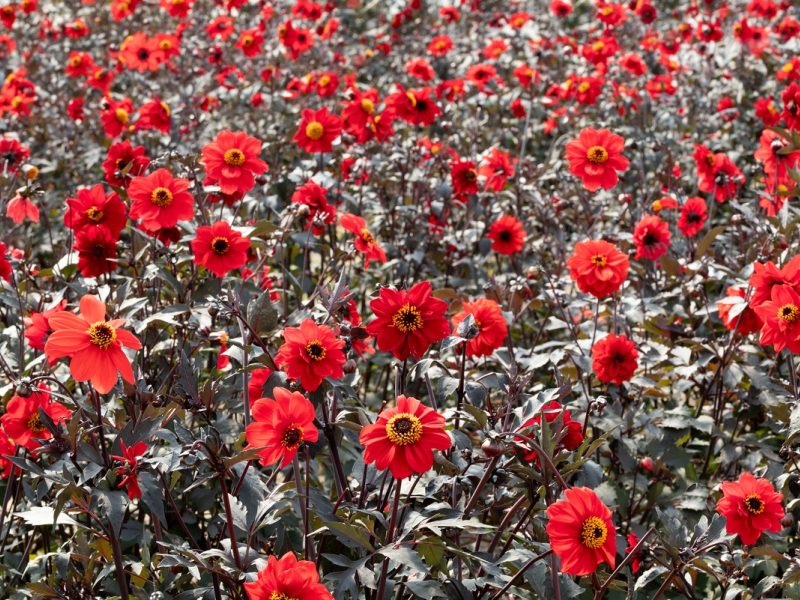
There is another difference that becomes visible once the plants start growing: seed-grown Dahlias are naturally less uniform than vegetatively propagated varieties. A cutting is essentially a clone of its mother plant, whereas plants grown from seed can show variation in characteristics such as colour, flower shape or plant habit.
For growers looking for maximum uniformity, this can be a disadvantage. But from another perspective, that variation can be part of the appeal. A seed-grown Dahlia crop can have a more playful and natural appearance, with individual plants offering small surprises.
What about flowering time?
There is a trade-off. Dahlias grown from seed require more time to establish than plants started from cuttings or tubers. As a result, they generally flower later.
For production planning, this difference needs to be taken into account. When an early flowering crop or a highly predictable, uniform end product is the priority, cuttings or tubers may therefore be the preferred option.
Seed or cutting? It depends on what you need
There is no single best way to grow a Dahlia. Cuttings and tubers offer advantages in uniformity and speed, while seed stands out for its lower cost, easy storage and transport, flexibility and reduced risk of carrying over certain plant health issues.
And then there is the variation. What can be considered a disadvantage when uniformity is essential can become an advantage when diversity is desired.
Ultimately, the choice depends on the grower, the market and the product they want to create. For those looking for an economical, flexible and slightly more surprising way to grow Dahlias, starting from seed offers an interesting alternative.
Discover our Dahlias
Interested in growing Dahlias from seed? Contact us to learn more about our available Dahlia varieties.